
One lesser-known benefit of owning a solar energy system is Solar Renewable Energy Credits (SRECs). SRECs may not be a household name, but they can drastically improve the financial returns of owning a solar system, which means putting more money in your pocket. They are a great addition to the electric savings and tax benefits you will gain with solar power.
If you’re new to solar energy, you probably have a lot of questions about Solar Renewable Energy Credits (SRECs). What exactly are SRECs? How do they work? And perhaps most importantly, how much are they worth? Don’t worry; this blog post provides all the answers you need and more.
What Is A Solar Renewable Energy Credit (SREC)?
 Solar Renewable Energy Credits (SRECs) come from a program called the Renewable Portfolio Standard (RPS). RPS, enacted by 36 states in some form or another, is designed to build utility companies' green portfolios. This is how states meet their energy production goals from renewable energy sources - like New Jersey’s 50% by 2030. SRECs are a carve-out of the RPS that requires a percentage of green energy production to be fulfilled by solar energy.
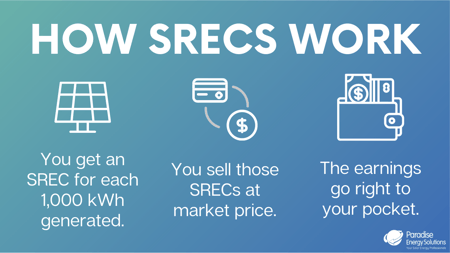
A solar panel system owner can receive 1 SREC for every 1,000 kilowatt-hours (kWh) or 1 megawatt-hour (MWh) of solar electricity produced by their panels. The system owner can then register and sell that credit, generating additional revenue.
Note: SRECs are only available for homeowners and businesses that own a solar system. Therefore, you will not be able to receive them if your system is leased or under a Power Purchase Agreement (PPA).
l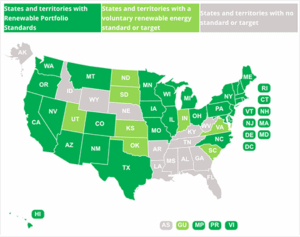
Check out this map from the National Conference of State Legislatures to see the states that have enacted Renewable Portfolio Standards regulations.
What States Are SRECs Available?
Although 36 states enforce RPS legislation, not all have a carve-out specifically for solar energy. Currently, five states plus Washington, D.C., have an SREC market. SREC requirements vary by state, so credit values also vary from state to state.
One specific regulation that varies by state is the solar system location requirement. A few states require SRECs to come from solar systems within their borders—New Jersey is one of them. In contrast, other states accept SRECs purchased from solar systems outside their borders. This could be a big benefit for solar panel owners in states without solar carve-outs, but on the flip side, these open-border policies will drive down SREC prices.
Here’s a list of the states that currently have an SREC market:
- Maryland
- Massachusetts (MA is no longer accepting new solar systems into its market)
- New Jersey
- Pennsylvania (The PA SREC market is now closed to all out-of-state systems)
- Ohio
- Virginia
- Washington, D.C. (closed to out-of-state systems)
How much are SRECs worth?
Several factors influence the value of SRECs, including market supply and demand. The supply of SRECs is determined by the number of qualified producers, which refers to homeowners and businesses that own solar panel systems. If there are many qualified producers, SREC supply will increase, potentially driving down prices. On the other hand, if the number of qualified producers is limited, SREC supply may be scarce, leading to higher prices.
Demand for SRECs depends on how many credits utility companies must purchase to meet their renewable energy production goals. Each state sets a specific target for the percentage of green energy that utility companies must fulfill through solar energy. If utility companies do not purchase enough SRECs to meet these targets, they face fines known as Alternative Compliance Payments (ACPs). ACPs incentivize utility companies to buy SRECs rather than pay fines. However, if ACPs are set below the cost of an SREC, utility companies may choose to pay the fines instead, reducing demand and SREC prices.
To give you an idea of the potential financial benefits, let's consider a 10 kW residential system, which is the average size for a home. This system can generate approximately 12 SRECs per year. In states like New Jersey, where SREC prices are high, this could mean an additional $2,484 in your pocket annually. However, in states with lower prices, SREC earnings would likely range from $48 to $700 per year.
For the most up-to-date prices of SRECs, we recommend visiting SRECtrade, where you can find comprehensive information on the current market rates. The chart below lists the prices as of September 2026.
| State | SREC Price |
|---|---|
| Maryland | $43.00 |
| Massachusetts | $230.00 |
| New Jersey | $194.00 |
| Ohio | $2.00 |
| Pennsylvania | $22.00 |
| Virginia | $21.00 |
| Washington D.C. | $376.00 |
It's crucial to remember that the value of SRECs can vary over time due to shifts in supply and demand and changes in policy.
How are SRECs sold?
To sell your SRECs, you must register your system with the Public Service Commission and submit the registration to the Generation Attribute Tracking System (GATS). Once GATS approves your registration, your system will start generating credits. Thankfully, in most cases, your installation company will handle the registration process for you.
Once your system is registered and starts generating credits, you will need to decide the best way to sell them. You can use a broker to handle sales to utility companies, or you can have your installer manage the sale for you. Both choices will come with a fee, typically a percentage of the total sale amount.
Paradise Energy will manage SRECs for you, whether we installed your solar panels or you used another installation company. All are welcome.
How Does Paradise Energy Handle Customer SRECs?
At Paradise Energy, we gather all our customers' credits to sell directly to a broker, relieving our customers of the hassle and ensuring they get the best possible price for their credits.
Our SERC management service costs 6% of the sale amount per credit, with a minimum charge of $4 per credit.
The frequency at which we sell SRECs we manage varies by state. In Ohio and Virginia, we conduct sales once annually, while in Pennsylvania, Maryland, and New Jersey, we can sell them twice a year.
We provide this service as an additional offering for all the systems we install, as well as for those who have a system installed by another provider.
Please be aware that income generated from the sale of SRECs is considered taxable income.