For businesses in nearly any industry, commercial solar offers a smart way to take control of rising electricity costs. It’s not just about savings—it’s also about taking advantage of tax incentives, building energy independence, and enhancing your company’s reputation as a sustainability leader.
That said, the performance of your commercial solar energy system hinges on picking the proper equipment, and the solar panels are a huge component of that.
In this blog, we’ll discuss what to look for in commercial solar panels and share the top panel brands we recommend to our business customers.
The Top Commercial Solar Panel Brands of 2026
We’ve installed thousands of systems across the Mid-Atlantic and evaluated dozens of solar panel brands over the years. Based on our hands-on experience, here are the three commercial solar panel manufacturers we recommend for 2026.
| Brand | Efficiency | Product Warranty | Performance Warranty | Price Tier | Domestic Content Eligible |
|---|---|---|---|---|---|
| SEG Solar | 22.0–22.65% | 15 years | 30 years | Competitive | No (assembled in U.S., cells imported) |
| AXITEC | 21.0–21.3% | 15 years | 25 years | Most Economical | No |
| Silfab Solar | ~21.1% | 25 years | 30 years | Premium | Yes (U.S. cells + modules) |

SEG Solar – Best All-Around Solar Panel
Efficiency: 22.0% – 22.65%
Product Warranty: 15 years
Performance Warranty: 30 years
Manufacturing: U.S. & Southeast Asia
Price: Competitive
SEG Solar is quickly becoming our go-to panel for commercial solar projects. Originally chosen for their strong offering in the mid-size commercial space, SEG has proven reliable across all system types—rooftop, ground mount, and everything in between.
They offer top-tier efficiency and strong warranties, and they manufacture in Texas as well as Asia. However, note that while SEG panels are U.S.-assembled, they do not currently use U.S.-made cells, so they don’t qualify for the domestic content tax credit adder on ground mounts.
Still, for most commercial solar installations, SEG strikes the best balance of value, performance, and availability.

AXITEC – Best value Solar Panel
Efficiency: 21.0% – 21.3%
Product Warranty: 15 years
Performance Warranty: 25 years
Manufacturing: Southeast Asia & Middle East
Price: Most Economical
If you’re looking for affordable commercial solar panels that maximize ROI, AXITEC is hard to beat. Their panels are reliable and widely available making them an ideal choice for larger-scale commercial and industrial solar systems where keeping costs down is a priority.
AXITEC panels offer average efficiency and durability, but their customer service is exceptional, and they’ve been a consistent partner over the years. Just be aware that their panels are slower to market with the latest technologies and are not eligible for the domestic content bonus.

Silfab Solar – Best for Domestic Content Incentives
Efficiency: ~21.1%
Product Warranty: 25 years
Performance Warranty: 30 years
Manufacturing: U.S. & Canada (including U.S.-made cells)
Price: Premium
If your business is installing a ground-mounted system and wants to take advantage of the 10% Domestic Content Bonus, Silfab is one of the only panel manufacturers that qualifies. They produce both the modules and the solar cells in North America.
Performance is excellent, and Silfab offers strong warranties and very good temperature coefficients. These panels are more expensive, but for many commercial projects, the federal solar tax credit savings more than make up for the premium.
Heads up: Silfab’s domestic content panels are in limited supply, so availability may be a concern. Be sure to start your planning early if you want to use them.
Key Factors When Choosing Commercial Solar Panels
Not all commercial solar panels are created equal. Each brand has its strengths: efficiency, cost, warranties, or domestic manufacturing. The right panels for your business will depend on your goals, site conditions, and budget.
Here are the most important factors to consider:
1. Type of Panel: Monofacial vs. Bifacial
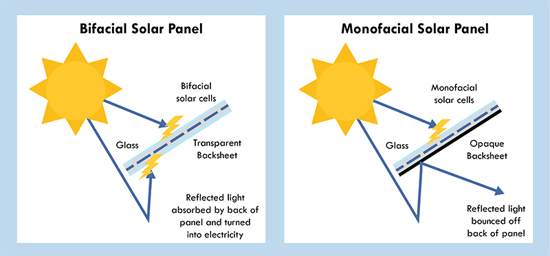
Monofacial panels generate power from one side (the front) and are ideal for most roof-mount systems or surfaces with little light reflection.
Bifacial panels generate power from both sides and are often used in ground-mounted commercial solar systems or installations above reflective surfaces like light-colored gravel or white membranes.
2. Cost vs. Value
Your goal shouldn’t just be the cheapest panel—it should be the one with the best return on investment. A lower-priced panel may come with longevity, efficiency, or warranty trade-offs. Conversely, some premium panels justify their price through added production or eligibility for additional tax credits like the Domestic Content Bonus.
When considering the value, look at:
- The initial cost
- Energy production over time – efficiency and degradation
- Warranty coverage
- Qualification for domestic content tax credit adder
3. Panel Efficiency
Solar panels with higher efficiencies produce more electricity than those with lower metrics. This means more free electricity overall or a potentially smaller system with fewer panels. That said, efficiency isn’t everything, and unless space is in small supply for your commercial system, you may be better off with a panel that’s slightly less efficient but more affordable.
When evaluating efficiency, several different factors must be considered. First, the efficiency rating on the solar panel measures how much of the sun’s energy is converted to electricity. Most panels on the market today range from 19% to 22% efficiency. The most efficient panels available for commercial use are around 23%.
Another important factor is the temperature coefficient of Pmax or Pmpp. This measures how well the solar panels will perform in high temperatures. We typically recommend panels of -0.35% per degree C or lower.
4. Warranty & Durability
Your solar panels are expected to operate for 25 years or more. That’s why it’s critical to choose a manufacturer that offers strong warranties and builds panels that last.
Look for:
- Product warranty (covers defects): 12-25 years
- Performance warranty (covers energy output over time): 25-30 years
And remember, even the best equipment needs routine care. A solid solar panel maintenance plan helps protect your investment and keeps production on track.
5. Manufacturer’s Reputation & Financial Stability
Even the best warranty is meaningless if the manufacturer is no longer around to honor it. That’s why the manufacturer’s reputation and financial stability are so important. Be sure you’re choosing to install panels from a company that has a great reputation for customer service and quality products.
Responsible management of finances and products is a good sign that they’ll be around for the next 25 years to honor those warranties in case something goes wrong.
The best commercial solar panel isn’t always the one with the highest specs. It’s the one that meets your site’s goals and budget. That’s why we back every system we install with our Triple Ten Guarantee – 10 years of free monitoring, maintenance, and production coverage.
What Solar Panels Should Your Business Install?
Choosing the right panel is just one step in building an efficient, cost-effective solar system. At Paradise Energy, we take a consultative approach to commercial solar, helping businesses design custom systems using the best technology for their unique situation.
We’ll walk you through your options and help you evaluate which commercial solar panels offer the best return on investment.
Ready to take the next step? Contact us to speak with your local solar consultant.
Frequently Asked Questions About Commercial Solar Panels
Are commercial solar panels worth it?
For most businesses, yes. Commercial solar panels typically pay for themselves in 5–8 years through electricity savings, the federal solar tax credit, accelerated depreciation, and state incentives. After payback, your business enjoys decades of free or dramatically reduced electricity. Use our Solar ROI Calculator to estimate your savings.
What is the difference between commercial and industrial solar panels?
The panels themselves are often the same. The distinction is really about system size and application. Commercial solar systems typically serve offices, retail spaces, and small-to-mid-size businesses. Industrial solar installations tend to be larger-scale systems for manufacturing facilities, warehouses, and distribution centers.
How long do commercial solar panels last?
Most commercial solar panels are warranted for 25–30 years of performance, and many continue producing electricity well beyond that. The key is choosing a manufacturer with strong warranties and a track record of financial stability so they’ll still be around to honor those warranties decades from now.
What size solar panel system does my business need?
System size depends on your electricity usage, available roof or ground space, and your savings goals. A 100 kW system might work for a mid-size office, while a warehouse or manufacturing facility could need 500 kW or more. Our team can design a system that matches your specific needs. Start with a free solar price estimate.