KEY TAKEAWAYS
- kWh tells you the tank size. kW tells you the flow rate. Energy capacity and power output are two separate specs, and it’s the power rating that limits what you can actually run in your home at one time.
- Full-house battery backup carries a steep price tag. Without a generator or changes to how you use energy, covering every circuit can push total system costs into six figures, which is why most homeowners back up only their essential loads instead.
- Two batteries with the same rating won’t necessarily perform the same. The real determining factor is whether the inverter and battery are properly paired, since a mismatch can bottleneck how fast stored energy reaches your home.
- Net metering changes the math on battery savings. If your utility credits excess solar at the full retail rate, storing that power in a battery instead of exporting it won’t put extra money in your pocket, though it still protects you when the grid goes down.
- A battery on its tenth birthday isn’t the same battery you bought. Warranty terms typically permit a 30-40% drop in capacity, so noticeable performance loss can show up well before the warranty period ends, sometimes within the first five years.
What if the battery you bought could power only half as much as you thought, and you found out the night your power went out?
Home solar batteries can be confusing. Between the numbers, the technical terms, and the myths floating around online, it’s easy to end up buying way more battery than you need, or a lot less than you thought you were getting.
Below, we’ll break down five of the most common misconceptions we hear about home solar batteries.
What Does A Home Solar Battery Actually Do?
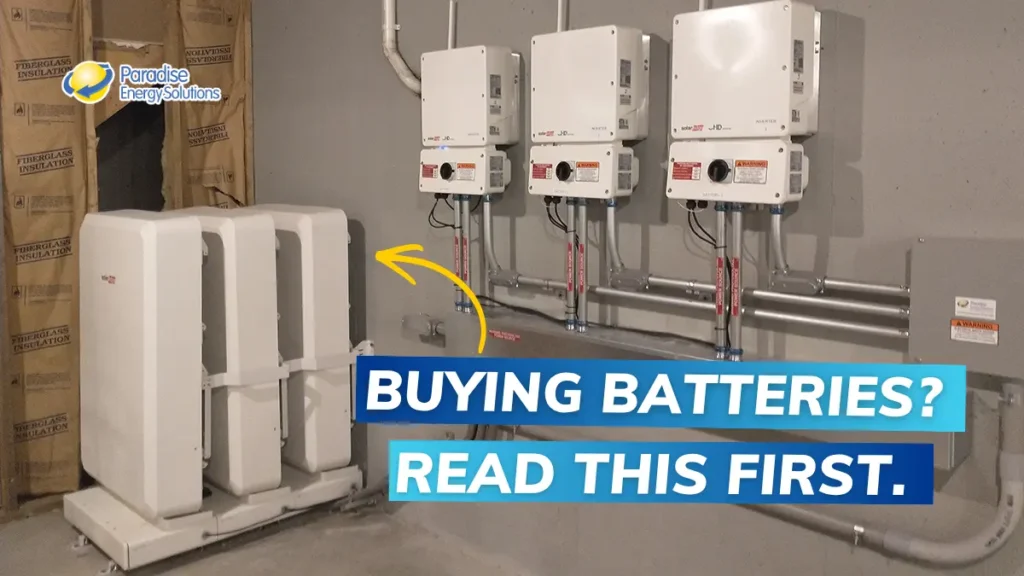
Before we get into the misconceptions, it helps to know what a battery is actually there to do. Home solar batteries serve two main functions:
- Storing extra solar power. Your battery can store the extra power your panels make during the day so you can use it later, instead of sending it back to the grid.
- Backing up your home. When the grid goes down, your battery can keep specific things in your house running, like your fridge, your well pump, or your Wi-Fi, so you’re not sitting in the dark waiting for the power to come back on.
That second reason, backup power, is why most homeowners install a battery today. Where it gets complicated is figuring out how much a battery can actually back up, how long it will last, and how well it holds up over the years. That’s where these misconceptions come in.
Misconception 1: A Bigger kWh Number Means More Power
A larger kilowatt-hour (kWh) rating does not automatically mean your battery can power more of your house. That’s not what that number actually tells you.
Here’s the difference:
- Kilowatt-hour (kWh) measures how much energy your battery can hold. Think of it like the size of a gas tank.
- Kilowatt (kW) measures the rate at which your battery can push power out at any given moment. Think of it like how fast fuel comes out of the pump.
So say you have a 15 kWh battery. That’s the size of the tank, the total energy it’s holding. But that same battery might only be able to push out 10 kW continuously. That 10 kW number, not the 15, decides what you can run in your home at once.
Here’s what that looks like in real life: if you’re pulling 10 kW continuously from a 15 kWh battery, it will only last about an hour and a half before it’s empty (not even accounting for degradation or other losses).
The battery size tells you how much fuel is in the tank. The kW rating tells you what it can actually do for you while that fuel lasts.
The takeaway: When you’re comparing types of home solar batteries, ask about both the kWh capacity and the continuous kW output, not just the bigger, more impressive-sounding number.
Misconception 2: Whole-Home Battery Backup Is Affordable
For most homes, backing up the entire house with battery power isn’t financially realistic, especially if you aren’t also adding a generator or changing how you use electricity. A true whole-home battery backup system can easily run into $100,000+.
Here’s why it gets so expensive. The loads that push a system the hardest usually hit in the winter, like your heat. That’s also when your solar production is at its lowest point all year. So you’re asking a system to do its biggest job at the exact time it’s making the least amount of power. To size a battery system for true whole-home backup in that scenario, you need far more battery capacity than most homeowners expect, and the cost adds up fast.
That’s why we typically talk to homeowners about a critical-loads approach instead. This means backing up the specific things that actually matter during an outage, like your fridge, your well pump, and some lighting and outlets, rather than trying to run the entire house as if nothing happened. It’s a smaller system that will cost closer to $30,000 than $100,000. And for most homes, it more than covers what people actually need during a short-term outage.
Misconception 3: All Battery Systems Perform The Same
If two battery systems are a similar size, it’s easy to assume they’ll perform the same. However, that’s not true. What actually determines performance comes down to three things:
- How much power your inverter can push out at any given time
- How much power your battery can push out at any given time
- How much energy your battery can actually store
A battery might have plenty of stored energy, but if the inverter and battery are poorly matched, they can’t deliver that stored energy fast enough to power your loads when you need it, like when your well pump or air conditioner kicks on.
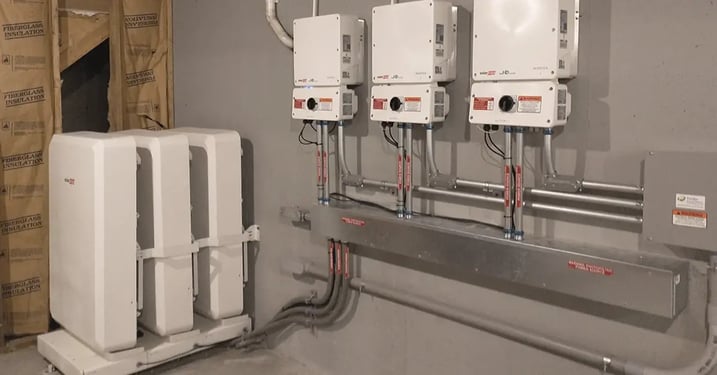
On top of that, you can’t just pair any inverter with any battery. They have to be compatible with each other, and that compatibility is part of what you’re actually paying for in a battery package, not just the battery itself.
The takeaway: Ask your installer how the inverter and battery capabilities in your proposed system match, not just how big the battery is.
Misconception 4: Storing Power At Night Always Saves You Money
Storing your solar power to use at night doesn’t always save you money. That’s only true in certain situations, and if you live in a net metering area, it’s likely not true for you at all.
Net metering applies when your panels make more power than your house uses. You send that extra power to the grid, and you get credited for it. If you’re storing power in a battery during the day just to use it at night instead of sending it back to the grid, you’re not gaining anything extra. You’re getting the same value either way. You’re simply choosing to store that value yourself instead of letting the utility hold the credit for you.
That said, net metering policies aren’t fixed, and they can change depending on where you live. Maryland, for example, is expected to move to a new policy called NEM 2.0 in 2027, which will change the rate homeowners get credited for their excess production. We don’t know the exact new rate yet, but it will likely be lower than the current retail rate. California implemented a similar policy change a few years ago. These are exactly the kind of changes that would make storing your own power in a battery worth more.
Where a battery does add real value right now, even in a net metering area, is backup power during an outage.
The takeaway: If someone tells you a battery will save you extra money every night just by storing power instead of exporting it, and you’re in a net metering area, that’s not accurate. Ask how net metering works where you live before assuming a battery will lower your bill.
Misconception 5: A Battery Performs The Same After 10 Years As It Did On Day One
This last misconception applies to any battery system: a battery doesn’t perform the same after 10 years as it did on day one, and the warranty doesn’t protect you the way most people assume.
Most battery warranties allow for 30 to 40% degradation over a 10 to 15 year period. That sounds like a long, gradual slide. But if you do the math, a battery can lose close to 15% of its capacity in just the first five years and still not trigger a warranty claim. That means you could lose a significant amount of performance within just a few years.
This connects directly back to misconception #1, the kWh number on the spec sheet. Whatever capacity you’re buying today, plan on having meaningfully less than that a few years down the road. If you size your system around exactly what you need right now, you’ll feel that degradation sooner than you’d expect.
The takeaway: Build some flexibility into your plan, both in what your battery covers today and what it will still be able to cover in five or ten years, because it won’t be the same battery it was on day one.
Questions To Ask Before You Buy A Home Solar Battery
Before you sign anything, get straight answers from your installer on these questions:
- What is the continuous kW output, not just the kWh size?
- How are the inverter and battery matched for my specific needs?
- What degradation should I expect over the warranty period?
- Does my area have net metering, and how does that affect a battery’s value?
- If I’m buying for backup, what exactly will it cover, and for how long?
Get A Straight Answer On What You Actually Need
Home solar batteries can be one of the most confusing parts of going solar. Whether you want to cover a few essentials during an outage or figure out what whole-home backup would really cost, you shouldn’t have to guess.
Use our Battery Price Estimator to pick the actual appliances you want backed up and see what equipment you’d need and what it would cost. Or reach out to one of our solar consultants for a straight answer on what makes sense for your home.